Water is one of the most important raw materials in food and beverage production. It is used directly in bottled water, juice, soft drinks, beer, and dairy products. It is also required for ingredient preparation, equipment washing, CIP cleaning, boiler feedwater, and package rinsing.
Excessive hardness, dissolved salts, chlorine, microorganisms, and organic matter in feedwater may affect product taste, color, odor, stability, and shelf life. Food and beverage manufacturers therefore need a properly designed pure water treatment system based on feedwater quality, product type, and required water specifications.
This guide explains the applications, treatment processes, sizing principles, and maintenance requirements of pure water systems for food and beverage production.
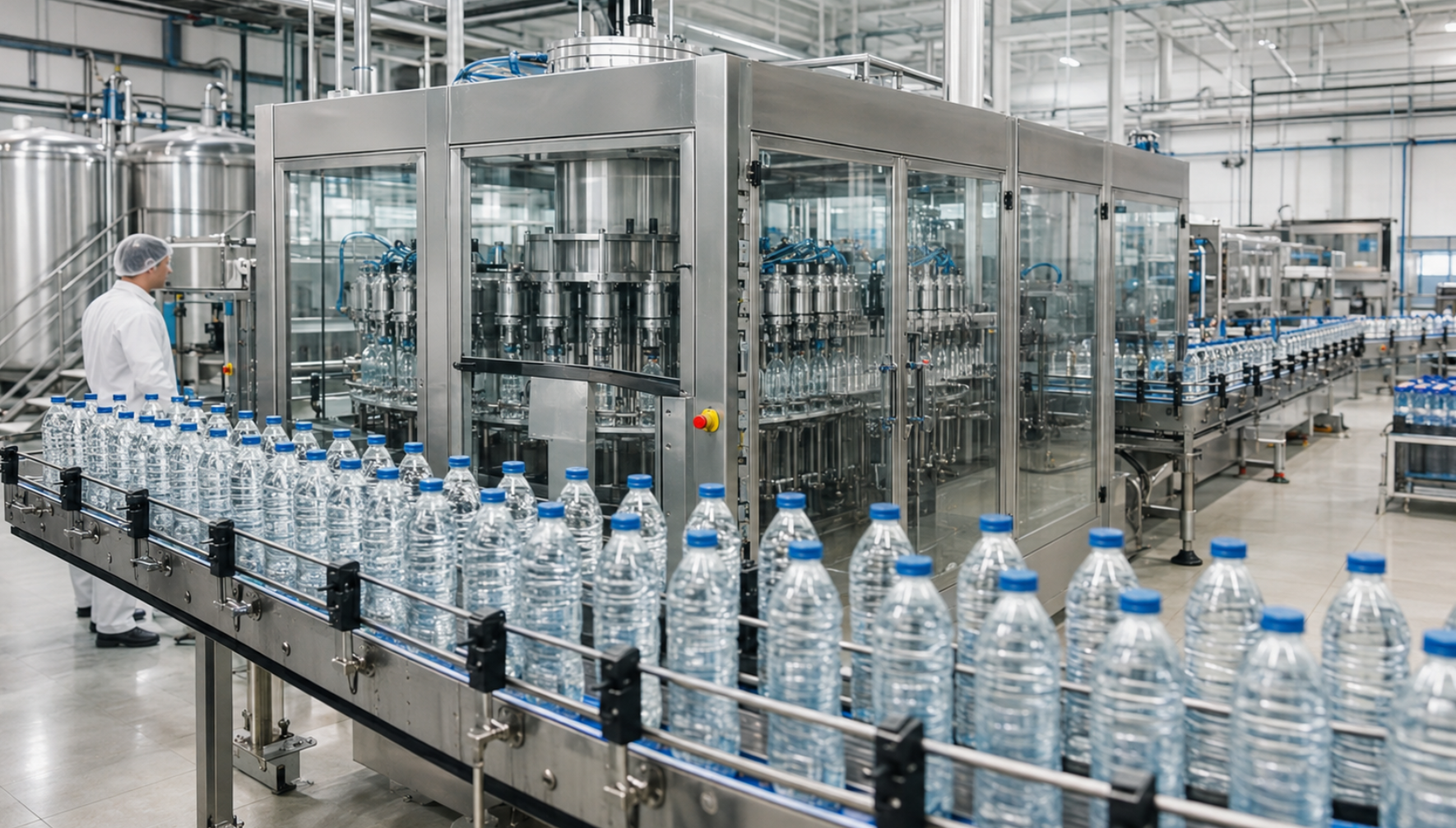
Municipal water, borehole water, river water, and other water sources can have very different characteristics. Even water that meets local drinking-water requirements may not be suitable for direct use in a specific food or beverage process.
The main purposes of water treatment include:
The treatment process should be selected according to a water analysis and the final product specification.
Bottled-water systems commonly remove suspended solids, hardness, dissolved salts, odors, and microorganisms. A typical system may include multimedia filtration, activated carbon filtration, cartridge filtration, reverse osmosis, ozone disinfection, and UV sterilization.
Water can affect the taste, appearance, and stability of juice and plant-based beverages. Purified water is used for ingredient preparation, concentrate dilution, equipment cleaning, and container rinsing.
Carbonated beverages require consistent ingredient water. Variations in hardness, alkalinity, chlorine, and dissolved salts may affect flavor, clarity, and formulation stability.
The mineral composition of brewing water can influence fermentation and final flavor. An RO system can reduce inconsistent salts in the feedwater, after which selected minerals may be adjusted according to the product recipe.
Treated water may be used for ingredients, cleaning, CIP systems, and boiler feedwater. Dairy water systems should emphasize microbiological control, hygienic piping, and reliable water supply.
Pure water systems can serve canned-food, condiment, bakery, confectionery, frozen-food, and prepared-food plants. Applications include ingredients, washing, steam generation, and other production processes.
Treated water helps reduce scale and residues on bottles, pipes, filling machines, and heat-exchange equipment.
The process should be customized according to the feedwater and final water-quality requirements. A typical process is:
Feedwater → Raw-Water Tank → Feed Pump → Multimedia Filter → Activated Carbon Filter → Water Softener or Antiscalant Dosing → Cartridge Filter → High-Pressure Pump → RO System → Product-Water Tank → UV or Ozone Disinfection → Final Filter → Points of Use
A multimedia filter reduces sediment, rust, suspended solids, and turbidity, protecting downstream treatment equipment.
Activated carbon adsorbs residual chlorine, odors, color, and some organic matter. Chlorine removal is particularly important for protecting polyamide RO membranes.
When the feedwater has high hardness, a water softener or antiscalant dosing system can reduce the risk of calcium, magnesium, and other salts forming scale on RO membranes.
A cartridge filter is normally installed before the high-pressure pump and RO membranes to capture fine particles.
The RO system is the main purification stage. It uses semipermeable membranes to reduce dissolved salts, hardness, some organic compounds, and microorganisms, providing more consistent product water.
UV systems disinfect water without adding chemicals. They are commonly installed after the purified-water tank or close to the final point of use.
Ozone may be used for microbiological control in bottled-water plants, storage tanks, and circulation systems. The required ozone concentration and contact time should be determined for each project.
A final filter can be installed before ingredient preparation or filling to reduce particles and microbiological risks introduced during storage and distribution.
RO treatment reduces the effect of variations in feedwater, helping maintain stable conductivity and dissolved-solids levels.
Reducing chlorine, odors, and excessive minerals can improve the taste, smell, and clarity of finished products.
Lower hardness and dissolved-salt levels reduce scale in pipes, boilers, heat exchangers, and filling equipment.
With suitable pretreatment, RO systems can treat municipal water, borehole water, and some higher-salinity sources.
Industrial RO systems can include PLC control, touchscreen operation, conductivity monitoring, flowmeters, pressure sensors, and automatic membrane flushing.
Capacity can be expanded by adding membrane units or installing additional RO systems in parallel.
A water analysis should include:
These parameters determine the pretreatment process, membrane selection, system recovery, and cleaning plan.
Water used as a product ingredient may have different requirements from floor-washing water or boiler feedwater.
Dividing water into different quality levels can avoid treating all factory water to the highest specification, reducing capital and operating costs.
A preliminary sizing formula is:
Required RO capacity = Daily purified-water demand ÷ Effective operating hours × Safety factor
If a factory requires 80 m³ per day, operates the system for 16 hours, and allows a 15% capacity margin:
80 ÷ 16 × 1.15 = 5.75 m³/h
A 6 m³/h RO system may be considered.
If filling or CIP cleaning takes place within a limited period, peak water demand must also be calculated. A suitable product-water tank and distribution pump should be included.
Before system design, confirm:
Each project should be designed according to its applicable requirements.
Single-pass RO is commonly used for:
It has a simpler process, lower investment cost, and easier maintenance.
A double-pass RO system treats the first-pass product water again through a second RO stage. It may be selected for:
The final decision should be based on feedwater quality and the required product-water specification.
Material selection should consider hygiene, corrosion resistance, cleaning requirements, and applicable regulations.
Common materials include:
Systems requiring hot-water sanitization, chemical disinfection, or higher hygienic performance should also consider surface finish, weld quality, drainability, dead legs, and circulation design.
Poorly designed storage and distribution systems can allow purified water to become contaminated after RO treatment.
Important considerations include:
Water quality should be controlled from the feedwater inlet to the final point of use.
Food and beverage RO systems may include:
Automation improves operating consistency, but trained personnel should still conduct inspections and preventive maintenance.
RO recovery rate is calculated as:
Recovery rate = Product-water flow ÷ Feedwater flow × 100%
If the feedwater flow is 10 m³/h and the product-water flow is 7 m³/h:
Recovery rate = 7 ÷ 10 × 100% = 70%
Major operating costs include:
A higher recovery rate can reduce concentrate volume, but excessive recovery may increase membrane scaling. The correct recovery rate should be based on water analysis and membrane projection calculations.
A preventive maintenance program should include:
If product flow decreases, pressure drop increases, or salt rejection declines, operating data and feedwater changes should be reviewed before membranes are cleaned or replaced.
Avoid the following mistakes:
Provide the manufacturer with:
A pure water system for the food and beverage industry should be designed according to feedwater quality, product type, production capacity, peak demand, and final water specifications.
A complete solution may include pretreatment, reverse osmosis, purified-water storage, disinfection, and hygienic distribution. Proper system design can stabilize ingredient-water quality, reduce scaling, improve production consistency, and control long-term operating costs.
For a customized food and beverage water treatment solution, send Zhongnuo Water Treatment your feedwater analysis, required capacity, application, product-water specification, and local power supply. Our engineers can recommend an appropriate process and equipment configuration.