Mining operations require large and stable water supplies for mineral processing, dust suppression, equipment cleaning, cooling, worker accommodation, and daily production. However, many mines are located in remote areas where municipal water infrastructure is unavailable and groundwater may contain high levels of salts, suspended solids, heavy metals, or other contaminants.
A properly designed mining water treatment solution can convert groundwater, brackish water, seawater, or surface water into water suitable for industrial processes and worker consumption. Technologies such as reverse osmosis, ultrafiltration, pretreatment, water softening, and containerized water treatment systems help mining companies improve water reliability, reduce operating risks, and support continuous production.
This guide explains the main water challenges faced by mining operations, the technologies commonly used in mining water treatment, and how to choose the right system for a specific project.
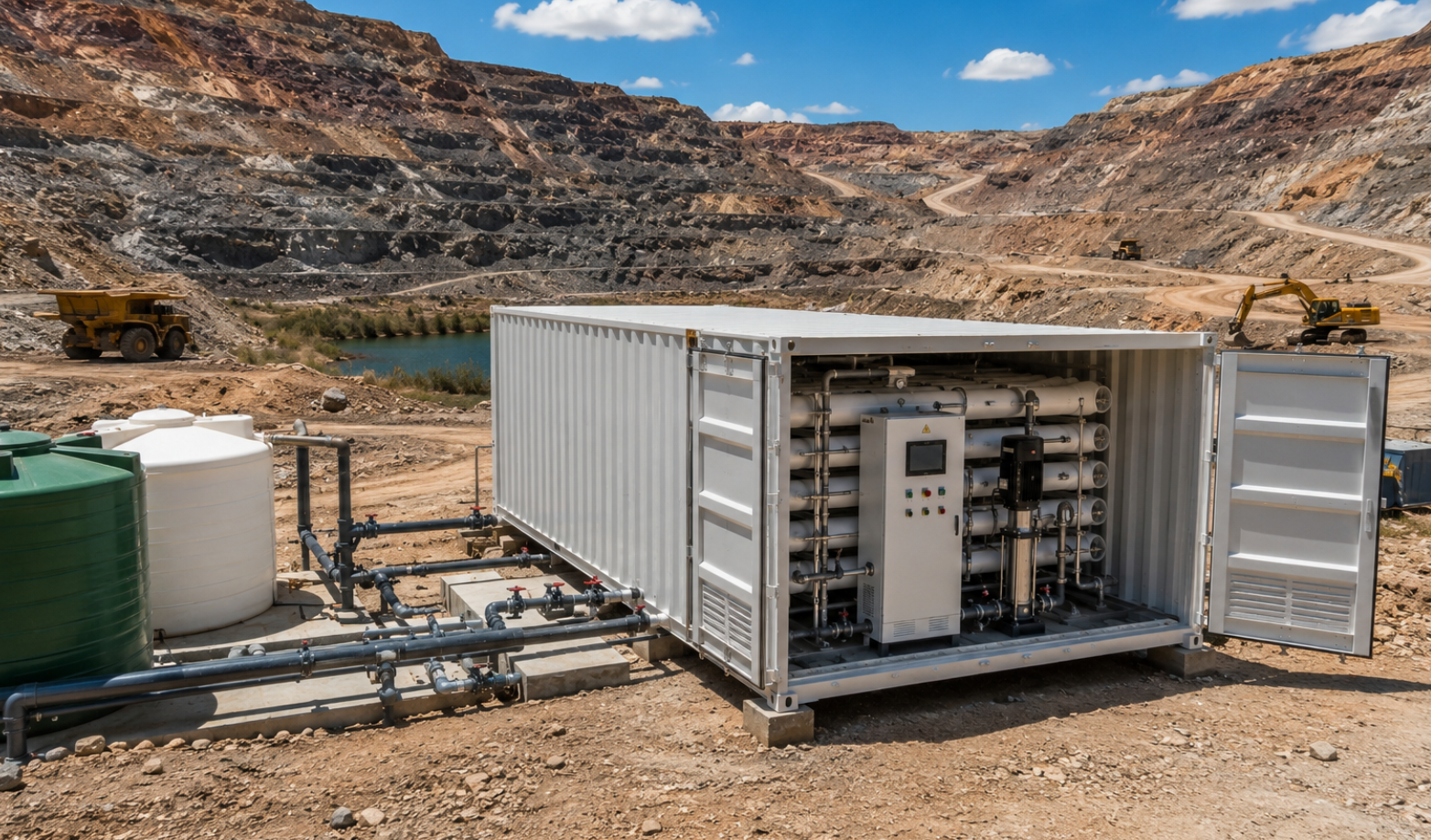
A mining water treatment system is a customized combination of filtration, desalination, purification, and disinfection technologies designed to treat water used or generated during mining activities.
Depending on the water source and the required product-water quality, a mining water treatment plant may include:
The correct treatment process depends on the raw-water analysis, production capacity, mine location, final application, environmental conditions, and local discharge requirements.
Water quality directly affects mining productivity, equipment reliability, operating costs, and worker safety. Untreated or poorly treated water can cause scaling, corrosion, membrane fouling, blocked pipelines, unstable process performance, and premature equipment failure.
A reliable industrial water treatment system helps mining companies:
For mines operating in arid regions, coastal locations, deserts, mountains, or isolated industrial zones, onsite water treatment is often more practical than transporting freshwater over long distances.
Groundwater near mining sites may contain high concentrations of dissolved salts. Excessive salinity can make the water unsuitable for drinking, equipment washing, mineral processing, boiler feed, and other industrial applications.
A brackish-water reverse osmosis system can reduce total dissolved solids and produce low-salinity water for production or domestic use.
For coastal mining operations, a seawater reverse osmosis system can convert seawater into freshwater.
Surface water and mine water may contain sand, clay, sediment, metal particles, and other suspended materials. These contaminants can block valves, damage pumps, foul RO membranes, and reduce treatment efficiency.
Pretreatment technologies such as multimedia filtration, clarification, ultrafiltration, and cartridge filtration are commonly used before reverse osmosis.
Calcium and magnesium in raw water can form scale inside pipelines, pressure vessels, heat exchangers, boilers, and RO membranes.
Depending on the water quality, scaling can be controlled through:
Some mining water sources may contain iron, manganese, arsenic, fluoride, silica, sulfates, or other dissolved contaminants. These substances may affect production processes, worker health, equipment performance, or environmental compliance.
The treatment process must be selected based on a detailed water-quality report rather than relying on a standard equipment configuration.
Mining sites are often located far from cities, ports, roads, and service centers. Building a conventional water-treatment plant onsite may require extensive civil work, long installation periods, and specialized labor.
For this reason, many mining companies choose a containerized mining water treatment system that can be assembled, tested, and integrated before delivery.
Reverse osmosis is one of the most widely used technologies in mining water treatment. The system uses pressure to force water through semipermeable membranes, reducing dissolved salts, heavy metals, hardness, and many other contaminants.
An industrial RO system can be used to treat:
The final configuration may use a single-pass RO system or a double-pass RO system, depending on the required water quality.
Raw Water
↓
Raw Water Tank
↓
Raw Water Pump
↓
Chemical Dosing System
↓
Multimedia Sand Filter
↓
Activated Carbon Filter or Specialized Pretreatment
↓
Water Softener or Antiscalant Dosing
↓
Cartridge Filter
↓
High-Pressure Pump
↓
Reverse Osmosis Membrane System
↓
Product Water Tank
↓
UV Sterilizer or Additional Post-Treatment
↓
Industrial Water or Drinking Water Supply
The exact process should be adjusted according to the water analysis and the intended use of the treated water.
Ultrafiltration uses membrane technology to remove suspended solids, colloids, microorganisms, and high-molecular-weight contaminants.
A UF system is particularly useful when the raw water has:
Ultrafiltration can be used as a standalone treatment process or as pretreatment for a reverse osmosis system. When installed before RO, UF can help stabilize feed-water quality and reduce membrane fouling.
Brackish groundwater is a common water source in inland mining areas. Its salinity is higher than freshwater but lower than seawater.
A brackish-water desalination system can remove dissolved salts and produce water for:
Because brackish water normally requires lower operating pressure than seawater, it generally consumes less energy than seawater desalination.
Mining operations located near coastlines may have access to large amounts of seawater but limited freshwater resources.
A seawater reverse osmosis system typically includes:
Containerized seawater desalination systems are especially suitable for coastal mines, islands, offshore platforms, and temporary mining camps.
Water softeners use ion-exchange resin to reduce calcium and magnesium hardness.
Softened water can help protect:
However, a water softener does not remove all dissolved salts. When low-TDS water is required, a reverse osmosis system is generally needed after or instead of softening.
A containerized water treatment system for mining integrates the main treatment equipment inside a standard shipping container.
The container can include:
Most equipment is assembled and tested before shipment. This reduces onsite construction and commissioning work.
The complete system can be transported by truck, rail, or ship to remote mining locations.
The container protects equipment from dust, wind, sunlight, rain, and accidental damage.
Mining companies do not need to build a complete treatment room before equipment installation.
Additional containerized units can be added when mining production or worker demand increases.
For temporary projects, the system can be moved to another site after the mining phase is completed.
Treated water can support several mining activities.
Stable water quality helps maintain process consistency and protects production equipment.
Treated water may be used for road spraying, crushing areas, stockpiles, and material-handling zones.
Reduced hardness and suspended solids help prevent deposits on machinery and washing systems.
RO and additional polishing technologies may be used to produce low-conductivity water for boilers.
Controlled water quality reduces scaling, corrosion, and biological growth in cooling systems.
With proper treatment, disinfection, remineralization, and monitoring, purified water can be supplied to worker camps and offices.
Mining camps need reliable water for washing, kitchens, accommodation, and sanitation.
A mining water treatment plant should not be selected only by equipment capacity. The complete design should be based on actual project conditions.
A detailed water-quality report should include relevant parameters such as:
For seawater or highly saline groundwater, salinity and temperature are particularly important.
The required flow should be calculated according to:
For example, a mine requiring 120 cubic meters of purified water per day may need a different system depending on whether it operates for 10, 16, or 24 hours per day.
Water used for dust suppression does not require the same quality as boiler feed, laboratory water, drinking water, or mineral processing water.
Defining the final application prevents both under-treatment and unnecessary over-design.
The equipment supplier should understand:
Mining environments may be dusty, humid, corrosive, or exposed to salt air.
Depending on the water quality and operating conditions, equipment materials may include:
Material selection directly affects equipment durability and lifecycle cost.
Remote mining sites may have limited technical staff. Automated controls can simplify operation and reduce human error.
Useful functions include:
Mining water treatment equipment can be customized from small camp systems to large industrial plants.
Typical capacity ranges may include:
| Project Type | Typical Treatment Capacity |
|---|---|
| Exploration camp | 0.5–2 m³/h |
| Small mining camp | 2–5 m³/h |
| Medium mining operation | 5–20 m³/h |
| Large processing facility | 20–100 m³/h |
| Major mining project | Customized above 100 m³/h |
These figures are general references only. The correct capacity depends on daily demand, operating hours, raw-water quality, and the selected process recovery.
The cost of a mining water treatment system depends on several factors:
A low initial purchase price does not always mean a low total operating cost. Mining companies should also consider energy consumption, chemical consumption, membrane replacement, spare parts, maintenance requirements, and equipment service life.
Mining operators can improve system performance by following several practical measures.
RO membranes perform better when feed-water turbidity, suspended solids, hardness, and oxidation conditions remain controlled.
Operators should regularly monitor:
Membranes should be cleaned according to performance changes rather than waiting for severe fouling.
Remote mining sites should maintain critical replacement parts such as:
Basic training helps onsite staff identify abnormal pressure, reduced flow, conductivity changes, leakage, and dosing problems before they cause major shutdowns.
Zhongnuo Water Treatment designs and manufactures industrial water treatment equipment for different project conditions and water sources.
Available mining water treatment solutions include:
Each system can be customized according to the customer's:
As a factory-direct water treatment equipment manufacturer, Zhongnuo can provide equipment configuration, technical drawings, production, factory testing, installation guidance, operating instructions, and after-sales technical support.
There is no single standard system for every mine. The best solution depends on the raw-water quality, required capacity, final application, and installation conditions. Reverse osmosis is commonly used for desalination, while multimedia filtration, ultrafiltration, softening, and chemical dosing may be required as pretreatment.
Yes. Reverse osmosis can treat many types of mining groundwater, including brackish water. However, iron, manganese, hardness, silica, suspended solids, and other contaminants may require specific pretreatment.
Yes. A properly designed system can produce water for worker camps. The complete process may include RO, disinfection, remineralization, storage, and water-quality monitoring according to the applicable drinking-water requirements.
Yes. Containerized systems are especially suitable for remote mining sites because they reduce onsite installation work, protect the equipment, simplify transportation, and can be relocated when required.
The supplier normally needs:
Membrane life depends on feed-water quality, pretreatment performance, operating conditions, cleaning practices, and maintenance. Regular monitoring and timely chemical cleaning can help extend membrane service life.
A reliable mining water treatment solution is essential for mining companies operating in remote or water-scarce areas. By combining pretreatment, ultrafiltration, water softening, reverse osmosis, brackish-water desalination, or seawater desalination, mining operators can produce stable water for industrial processes, worker camps, cleaning, cooling, and other applications.
Containerized mining water treatment systems provide additional advantages, including fast deployment, reduced civil construction, easier transport, and protection in harsh environments.
To design the right system, mining companies should begin with a complete raw-water analysis and clearly define the required capacity, final water application, site conditions, and operating requirements.
Zhongnuo Water Treatment can provide customized mining water treatment equipment based on your project requirements. Contact us with your water-quality report, required flow rate, power supply, and application details to receive a suitable technical solution and quotation.