Reverse osmosis is one of the most widely used technologies for producing purified water in industrial, commercial, and drinking water applications. However, the performance of an RO system depends heavily on the quality of the water entering the system.
Feedwater containing high levels of hardness, suspended solids, chlorine, silica, iron, microorganisms, or dissolved salts can reduce permeate flow, increase energy consumption, damage RO membranes, and shorten the operating life of the entire system.
For this reason, a detailed feedwater analysis is essential before selecting or designing an industrial reverse osmosis system. Understanding feedwater quality allows engineers to choose the correct pretreatment process, membrane type, operating pressure, recovery rate, and cleaning schedule.
This guide explains how the main feedwater parameters affect RO system performance and how proper pretreatment helps maintain stable water production.
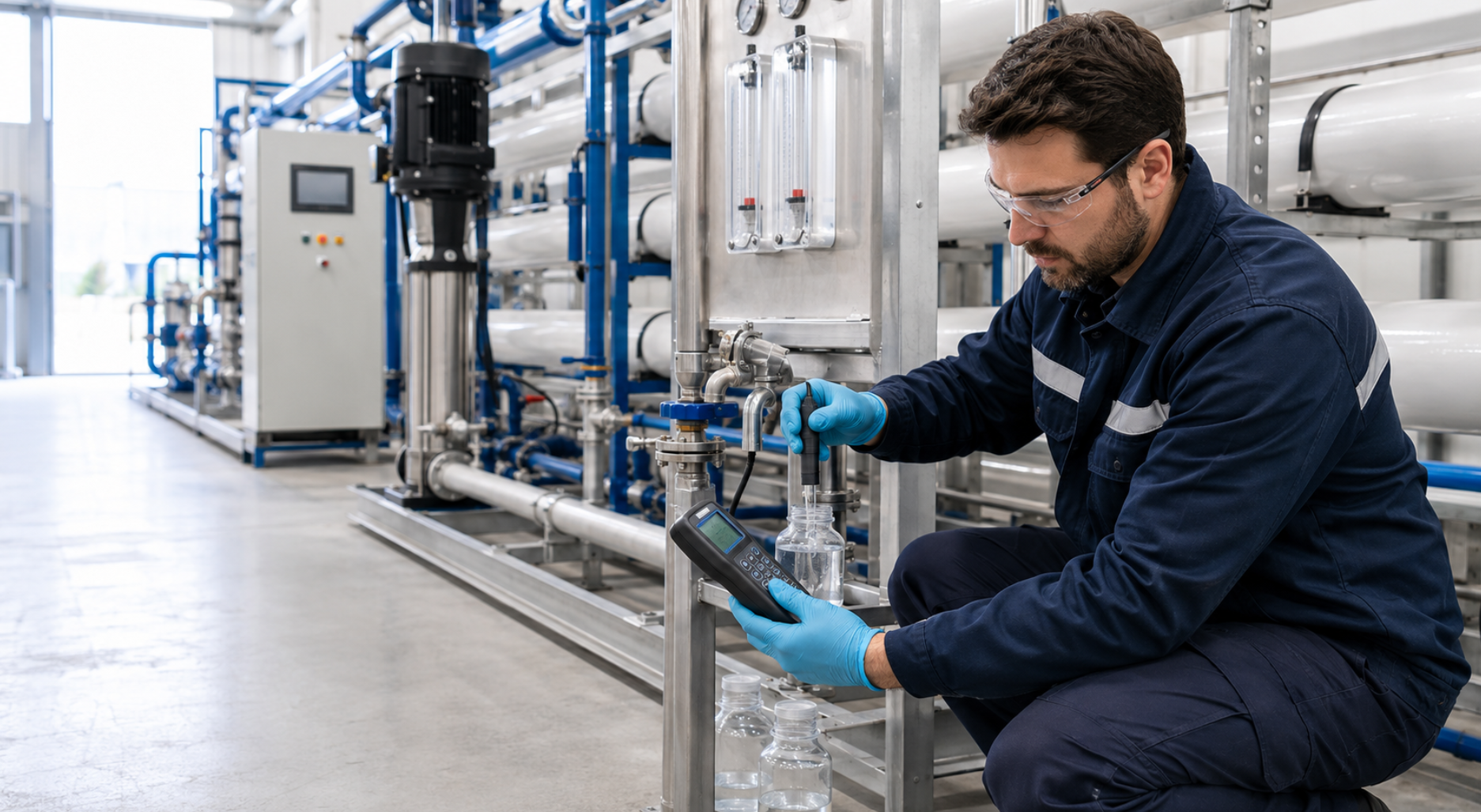
Feedwater is the untreated or partially treated water supplied to a reverse osmosis system. Depending on the project, the feedwater source may include:
Each water source has different physical, chemical, and biological characteristics. For example, municipal water may contain residual chlorine, while well water may contain high hardness, iron, manganese, silica, or dissolved salts.
Surface water usually has higher turbidity, organic matter, microorganisms, and seasonal water-quality variations. Seawater has extremely high salinity and therefore requires specialized high-pressure membranes and more comprehensive pretreatment.
There is no universal RO configuration suitable for every feedwater source. The system must be designed according to the actual water analysis and the required product-water quality.
RO membranes separate dissolved salts and other contaminants from water under pressure. Although RO membranes provide a high level of purification, they are sensitive to fouling, scaling, oxidation, and chemical damage.
Poor feedwater quality can cause:
A properly designed pretreatment system protects the RO membranes and allows the equipment to operate at a stable flow rate, pressure, recovery rate, and desalination efficiency.
Total dissolved solids, commonly known as TDS, represent the total concentration of dissolved salts and minerals in water. These may include calcium, magnesium, sodium, chloride, sulfate, bicarbonate, and nitrate.
A higher feedwater TDS requires greater operating pressure to overcome osmotic pressure. As TDS increases, the RO high-pressure pump consumes more electricity to produce the same amount of purified water.
High TDS may result in:
Standard brackish water RO membranes are commonly used for groundwater and other moderately saline water sources. Seawater, however, requires seawater RO membranes, corrosion-resistant components, and high-pressure pumps designed for much higher osmotic pressure.
TDS alone is not sufficient for selecting an RO system. The individual concentrations of calcium, sulfate, silica, iron, and other ions must also be evaluated.
Water hardness is mainly caused by dissolved calcium and magnesium ions. When water passes through an RO system, these minerals become concentrated on the feed side of the membrane.
If their concentrations exceed their solubility limits, mineral scale may form on the membrane surface. Common types of RO membrane scaling include:
Scaling blocks the membrane surface and reduces the amount of water that can pass through it. The RO system may then require higher pressure to maintain the required permeate flow.
Hard feedwater can cause:
Pretreatment options may include a water softener, antiscalant dosing system, pH adjustment, or a lower RO recovery rate. The correct solution depends on the complete water analysis and system operating conditions.
Turbidity indicates the presence of suspended particles such as sand, silt, clay, rust, and organic matter. These particles can accumulate on the membrane surface and create physical fouling.
High turbidity may lead to:
Multimedia filters, sand filters, ultrafiltration systems, and cartridge filters are commonly used to remove suspended solids before water enters an RO system.
For surface water or feedwater with significant seasonal variation, ultrafiltration can provide more stable pretreatment than conventional filtration alone.
The Silt Density Index, or SDI, is used to estimate the fouling potential of feedwater entering an RO membrane system. It evaluates how quickly suspended and colloidal particles block a standard test membrane.
A high SDI value indicates that the water has a greater potential to foul the RO membranes.
Industrial RO systems generally require a low and stable SDI. The acceptable value depends on the membrane manufacturer and the specific system design, but an SDI below 3 is commonly preferred for reliable long-term operation.
When SDI is too high, the pretreatment process may need to include:
Regular SDI monitoring helps operators evaluate whether the pretreatment system is working effectively.
Chlorine is commonly added to municipal and industrial water supplies for disinfection. However, many polyamide RO membranes are sensitive to chlorine oxidation.
Long-term exposure to free chlorine can permanently damage the membrane’s selective layer. Once oxidation occurs, the membrane may allow more dissolved salts to pass through.
Chlorine damage often causes:
Activated carbon filtration and sodium metabisulfite dosing are commonly used to remove free chlorine before the water reaches the RO membranes.
An oxidation-reduction potential instrument can also be installed to monitor dechlorination performance continuously.
Iron and manganese are frequently present in groundwater and well water. When exposed to oxygen or oxidizing chemicals, dissolved iron and manganese can form insoluble particles.
These particles may deposit on filters, pipelines, pressure vessels, and RO membrane surfaces.
Possible consequences include:
Iron and manganese should normally be removed before the RO stage. Common treatment processes include aeration, oxidation, manganese sand filtration, multimedia filtration, and ultrafiltration.
The selected process depends on the concentrations, oxidation state, pH, dissolved oxygen, and other feedwater characteristics.
Silica is one of the most challenging contaminants in RO water treatment. When silica becomes highly concentrated in the reject stream, it may form deposits that are difficult to remove through conventional membrane cleaning.
Silica scaling can cause:
A water analysis should clearly identify the silica concentration before system design. Depending on the results, engineers may reduce the recovery rate, adjust the pH, select a suitable antiscalant, or introduce additional treatment processes.
Feedwater pH affects the solubility of minerals, membrane rejection performance, chemical dosing requirements, and scaling potential.
High pH can increase the risk of calcium carbonate scaling. Low pH may increase corrosion and affect the rejection of certain contaminants.
Alkalinity, especially bicarbonate alkalinity, must be evaluated together with calcium hardness, pH, temperature, and system recovery rate.
pH adjustment may be used to:
Chemical dosing should be based on accurate water analysis and engineering calculations rather than estimation.
Natural organic matter may be found in rivers, lakes, reservoirs, groundwater, and reused water. Organic contaminants can adsorb onto the RO membrane surface and create an environment that supports microbial growth.
Organic fouling may cause:
Pretreatment solutions may include coagulation, activated carbon filtration, ultrafiltration, advanced oxidation, or other processes selected according to the type and concentration of organic matter.
Bacteria, algae, fungi, and other microorganisms can attach to membrane surfaces and form biofilms. This problem is known as biological fouling or biofouling.
Biofilms are difficult to remove because they can continue growing inside membrane housings, pipelines, tanks, and other system components.
Biofouling can result in:
Biological control may involve feedwater disinfection, ultrafiltration, activated carbon management, periodic sanitization, proper tank design, and strict control of stagnant water.
If chlorine is used for pretreatment disinfection, it must be removed before the water enters chlorine-sensitive RO membranes.
| Feedwater parameter | Potential effect on RO system | Common treatment method |
|---|---|---|
| High TDS | Higher pressure and energy consumption | Correct membrane and pump selection |
| High hardness | Membrane scaling | Softener or antiscalant dosing |
| High turbidity | Particle fouling | Multimedia filter or UF system |
| High SDI | Rapid membrane fouling | Improved pretreatment and UF |
| Free chlorine | Membrane oxidation | Activated carbon or dechlorination dosing |
| Iron and manganese | Deposits and membrane fouling | Oxidation and filtration |
| High silica | Difficult membrane scaling | Recovery control and antiscalant |
| Unstable pH | Scaling, corrosion, unstable rejection | Chemical pH adjustment |
| Organic matter | Organic and biological fouling | Activated carbon, coagulation or UF |
| Microorganisms | Biofilm formation | Disinfection and biological control |
The RO recovery rate is the percentage of feedwater converted into purified water.
For example, if an RO system receives 10 cubic meters of feedwater and produces 7.5 cubic meters of permeate, the recovery rate is 75%.
Recovery Rate=Permeate FlowFeedwater Flow×100%\text{Recovery Rate}=\frac{\text{Permeate Flow}}{\text{Feedwater Flow}}\times100\%Recovery Rate=Feedwater FlowPermeate Flow×100%A higher recovery rate can reduce water consumption and wastewater volume. However, increasing recovery also raises the concentration of salts and contaminants in the reject stream.
If the feedwater contains high levels of hardness, silica, sulfate, or other scale-forming substances, operating at an excessively high recovery rate may cause rapid membrane scaling.
The optimum recovery rate should therefore be calculated according to:
The highest possible recovery rate is not always the most economical operating point. A slightly lower recovery may provide more stable operation, longer membrane life, and lower total maintenance costs.
Water temperature directly affects membrane permeability. Cold water has a higher viscosity and passes through RO membranes more slowly than warm water.
As feedwater temperature decreases:
As water temperature increases, permeate flow generally increases. However, salt passage may also increase, which can affect the final product-water conductivity.
RO system capacity should therefore be calculated according to the lowest expected feedwater temperature, particularly in regions with significant seasonal temperature changes.
A professional industrial RO system should never be designed using capacity alone. Two customers may require the same permeate output but need completely different pretreatment systems, membrane configurations, pumps, materials, and chemical dosing systems.
A complete feedwater report should preferably include:
The required test parameters may vary according to the water source and application.
The equipment supplier should also know:
With this information, engineers can design a safer and more cost-effective RO water treatment system.
The following practices can improve RO system reliability:
Pretreatment should be designed according to the actual contaminants in the source water. Depending on the project, it may include:
Operators should regularly record:
Normalized performance data helps identify changes before serious membrane fouling occurs.
Chemical cleaning should be considered when normalized permeate flow decreases significantly, differential pressure increases, or salt rejection deteriorates.
Waiting too long may make the deposits more difficult to remove and can cause irreversible membrane damage.
The cleaning chemical and procedure must match the type of fouling. Acid cleaning, alkaline cleaning, disinfection, or specialized chemicals may be required depending on the membrane condition.
When an RO system remains unused, microorganisms can grow inside membranes and pipelines. Proper flushing, shutdown preservation, and regular sanitization help prevent biological contamination.
Feedwater quality is one of the most important factors affecting RO system performance, operating cost, water recovery, and membrane service life.
High hardness, turbidity, chlorine, iron, silica, dissolved salts, organic matter, and microorganisms can all reduce system efficiency if they are not properly controlled.
Before purchasing an industrial reverse osmosis system, customers should provide a complete water analysis and clearly define their required water capacity and product-water quality. This allows the equipment manufacturer to design the correct pretreatment process, membrane configuration, recovery rate, and operating parameters.
A customized RO system based on actual feedwater conditions provides more stable water production, lower energy consumption, fewer maintenance problems, and a longer equipment service life.
RO technology can treat many water sources, including tap water, well water, brackish water, and seawater. However, each source requires a different pretreatment process, membrane type, pressure level, and system design.
The ideal feedwater has low turbidity, a low SDI, no damaging level of free chlorine, controlled hardness, and low concentrations of iron, manganese, silica, organic matter, and microorganisms.
High TDS does not necessarily damage the membrane directly, but it increases osmotic pressure, energy consumption, concentrate salinity, and scaling risk. The system must use membranes and pumps suitable for the feedwater salinity.
Common causes include membrane scaling, particle fouling, organic fouling, biofouling, low feedwater temperature, insufficient pressure, damaged cartridge filters, and aging membranes.
Yes. The complexity of the pretreatment system depends on the feedwater quality. Even relatively clean municipal water normally requires cartridge filtration and chlorine control before entering the RO membranes.
Feedwater should be tested before system design and periodically during operation. More frequent testing is recommended when the water source changes seasonally or when system performance becomes unstable.
Need a customized industrial reverse osmosis system?
Zhongnuo Water Treatment designs and manufactures industrial RO, ultrafiltration, ultrapure water, water softening, brackish water desalination, seawater desalination, and containerized water treatment systems.
Send us your feedwater analysis, required treatment capacity, water application, and local power supply. Our engineering team will evaluate your water conditions and recommend a suitable treatment process.
Contact Zhongnuo Water Treatment for a customized water treatment solution.